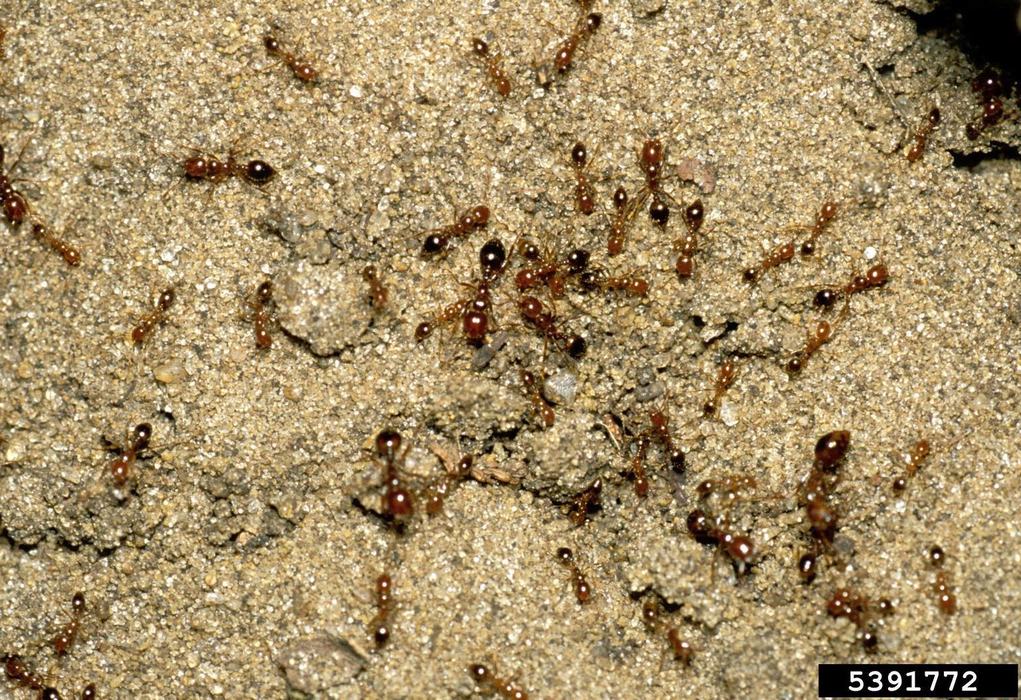
Have you experienced problems with fire ants this summer and fall? Due to recent rains, we have seen an abundance of mounds showing up everywhere. Fire ants have spread throughout much of the south and eastern parts of NC, and they are moving west. The main question most have is: How do you control these horrible ants?
Fire ant mounds vary in size due to the size of the colony. For example, a mound that is two feet in diameter and 18 inches high may contain about 100,000 workers, several-hundred winged adults and one queen. The mounds are often located in open areas such as pastures, fields, large lawns, etc. They can even be found around house foundations or inside houses.
During the spring and summer, winged males and females leave the mound and mate in the air. After mating, females become queens and may fly as far as ten miles from the parent colony. However, most queens descend to the ground within much shorter distances. Only a very small percentage of queens survive after landing. Most queens are killed by foraging ants, especially other fire ants. If a queen survives, she sheds her wings, burrows into the ground, and lays eggs to begin a new colony. In the fall, many small colonies of fire ants will appear. Many of the colonies will not survive the winter unless the weather is mild.
Fire ants prefer oily and greasy foods. They also feed on many other insects and from that standpoint, could be considered beneficial. To find food, workers forage around their mound often in underground tunnels that radiate from the mound. If the mound is disturbed, ants swarm out and sting the intruder.
Controlling these ants is almost impossible. However, your goal should be to manage the ants with chemical control and non-chemical control tactics. There are two approaches to chemical control. Each mound can be treated with an insecticide, or it can be broadcast over a wide area infested with fire ant colonies. Individual mound treatments are usually more environmentally friendly and effective. Mounds can be treated with a liquid or dust insecticide or with an insecticidal bait. If a liquid is used the mound must be drenched at a rate of approximately one gallon per six inches of mound diameter. Then thoroughly wet the ground to a distance of about two feet around the mound. The reason for this is that you need to reach the queen in order to kill the colony.
Ant baits are extremely effective. These baits are essentially a mixture of an insecticide and a food that is attractive to fire ants. The worker ants carry particles of the bait back to the mound and feed them to the immature ants and the queen. Keep in mind that even when the bait kills the queen, the workers may be active inside the mound for several weeks before the colony finally disappears.
Broadcast treatments should only be used in the case of potential human harm or when high mound densities are present over large areas. One disadvantage to broadcast treatments is that they can alter ant communities by killing all the native ants and turning the ant community into a dominated fire ant community.
The key to reducing fire ant infestations indoors is prevention, which means removing exposed food sources that may attract them. Properly labeled indoor insecticides can be used if nests are found inside dwellings or buildings. Baits are not recommended for indoor use due to the chance of attracting more ant species indoors.
For more information about fire ants and their management, contact your local N.C. Cooperative Extension, Franklin County Center at 919-496-3344.