White grubs are turf pests found throughout North Carolina. It is not uncommon to find 10 or more grubs per square foot feeding on grass roots. Heavily infested turf wilts or dies, often leaving the lawn feeling soft and spongy. Grubs may feed for several months before any turf damage becomes visible. Severely damaged turf may be rolled back like a carpet because its root system has been destroyed. Because of their underground feeding habits, white grubs are more difficult to detect and control than many of the pests that feed above ground. If they are promptly detected and identified, they can be controlled through treatments applied at the appropriate time. Outlined in this guide are proper scouting procedures for detecting grub infestations and guidelines for timing insecticide applications.
White grubs are the larvae of scarab beetles. The grubs of economic importance in North Carolina are those of the Japanese beetle, the green June beetle, the southern masked chafer, the northern masked chafer, and the Asiatic garden beetle. Several other species, such as May beetles and June beetles, are also present but usually in low numbers. The Japanese beetle is consistently the most damaging grub in this state. All these grubs have cream-colored bodies with yellow to brownish heads, brownish hind parts, and six legs. Mature grubs vary in length from 1/4 to 1-1/2 inches, depending on the species. White grubs usually lie in a curled or C-shaped position.
White grubs can be controlled in a timely and economical manner if proper controls are correctly applied at the right time. To prevent serious damage, examine all turf in April and again in August for the presence of grubs. Do not wait for brown patches to appear in the turf before inspecting the soil. Birds, moles, skunks and racoons all feed to some extent on grubs, and their digging in the lawn may be a sign of a white grub infestation. However, it is best to verify that grubs are actually present before applying pesticides. Use a heavy-duty knife or a spade to cut a 1-square-foot flap of sod and roll it back. Examine the soil and roots in the top 3 or 4 inches. Repeat this process in several locations. If you find an average of five or more grubs per square foot, a pesticide application is justified.
A biological treatment method, useful against only Japanese beetle grubs, is the application of milky spore bacteria. This commercially available bacteria, when applied to the soil, infects the grubs and produces a disease. Grubs in the soil come in contact with the spores through ingestion. The spores germinate inside the grubs, eventually killing them. These spores work best when applied in late September or early October to soil with a pH level between 6 and 7. The results are not as rapid as with chemical insecticides, but the effects last many years. When milky spore disease becomes established, it will spread naturally to adjoining, untreated areas.
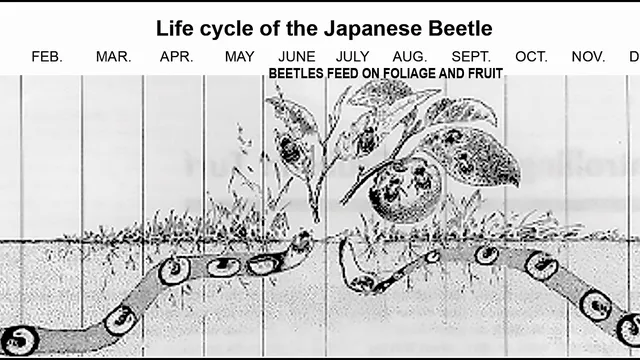
The timing of the insecticide application is critical if control is to be effective. There are two approaches, preventative and curative. Some of the newer products are preventative, and are most effective when applied prior to when the eggs are laid. The best time to apply curative insecticides is when the grubs are actively feeding near the soil surface. Pesticides applied any other time will be ineffective. As indicated in the life cycle chart below, this feeding occurs from August through October, and again in April through early May. Curative treatments applied in late summer or fall are usually more effective than spring applications because the grubs are small.
If you have questions about grubs or other gardening questions, contact your local N.C. Cooperative Extension Center at 919-496-3344.