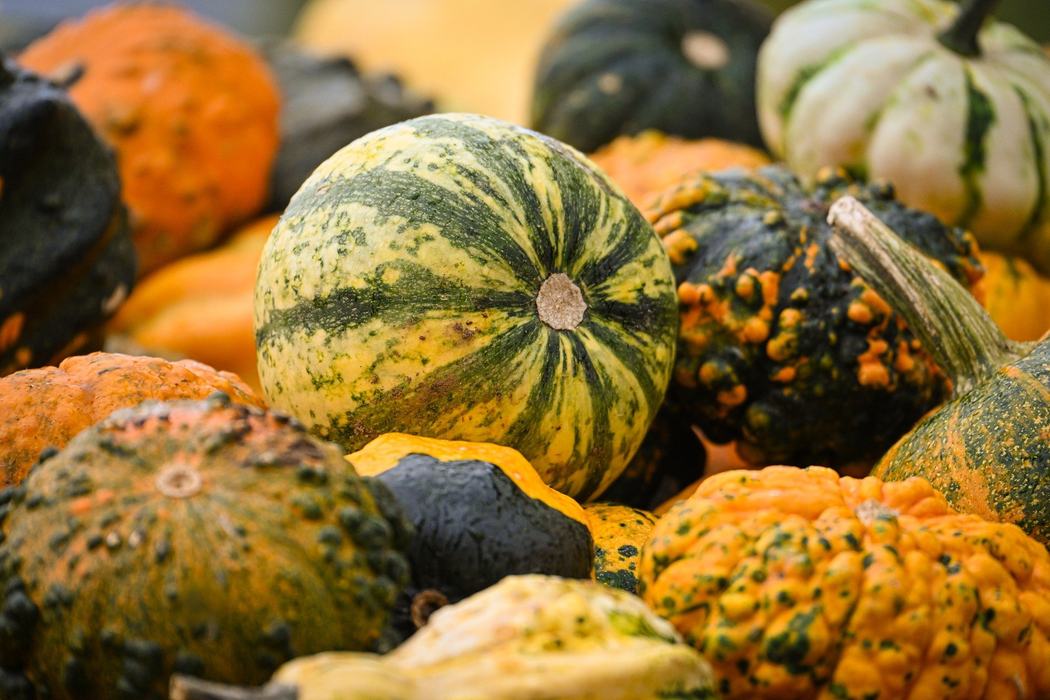
With a chill in the air, leaves beginning to turn color, and the days shortening, Fall is certainly upon us! What better representation of the season’s arrival than a classic pumpkin? Edible, experiential, and decorative, pumpkins are surely a fall staple that bring us together for memories that last.
Some of my favorite fall memories growing up include going on hay rides while visiting pumpkin patches, carving jack-o-lanterns with my family, and painting pumpkins with friends. Enjoying pumpkin pie at Thanksgiving is an obvious tradition, but I am particularly fond of the seeds. Growing up, I sometimes spent Halloween evenings at my friend’s house, and her family would always roast seasoned pumpkin seeds. Seems like pumpkins wind themselves into all of the fall memories.
Even though we typically think of round and orange when picturing pumpkins, they come in a wide variety of characteristics. Some are white, green, or even speckled. Pumpkins can be warty, oblong, or flatter in shape. There are miniature pumpkins and there are massive pumpkins. You can take a trip to the N.C. State fair to see the season’s largest pumpkins, some over 2,000 pounds!
According to the USDA, North Carolina produced over 45 million pounds of pumpkins in 2024. The majority of pumpkin production in our state is concentrated in the western region, where the climate and lower disease pressure is more conducive to pumpkin production. Nonetheless, pumpkins are still grown throughout our region. Who doesn’t want to lean into autumnal appreciation? We grow them more often for agritourism and ornamental purposes as opposed to for consumption.
For our region of North Carolina, the journey to growing your own pumpkins begins with planting anywhere from mid-April to early July. Pumpkins typically require anywhere from 90-120 days until maturity, depending on the cultivar you are planting. Pumpkins need space, with about four-six feet needed between each plant and eight-ten feet needed between each row. They also require full sun and moist, well-draining soils with a pH of 6.0-6.5.
Unfortunately, we aren’t the only ones that enjoy pumpkins. Common insect pests include squash bugs, cucumber beetles, and squash vine borers. Fungal diseases such as downy and powdery mildew are also common. Crop rotation is a good tool to prevent pest issues, and utilizing insecticides and fungicides helps in managing any issues. Drip irrigation is also a good option as opposed to overhead watering to avoid disease.
Once your pumpkin is ready for harvest, indicated by even coloring and hardening of the rind and stem, cut the stem, leaving at least three inches. Make sure not to pick up the pumpkin by the stem, which can damage it and cause it to go bad faster. To maximize your pumpkin’s shelf life, make sure to cure it. This process further hardens the rind and stem, and it includes keeping the pumpkin in a warm environment, around 80oF, with good air flow for 7-10 days. Curing will help your pumpkin last up to 3 months.
You have lots of options when it comes to this fall fruit. You can choose how you obtain the pumpkin, the color, size, and how you use it. Whatever you choose your pumpkin experience to be, you are sure to embrace the fall spirit!
For more information or questions, contact N.C. Cooperative Extension, Franklin County Center at 919-496-3344, Ag Agent, Alejandra Martinez.