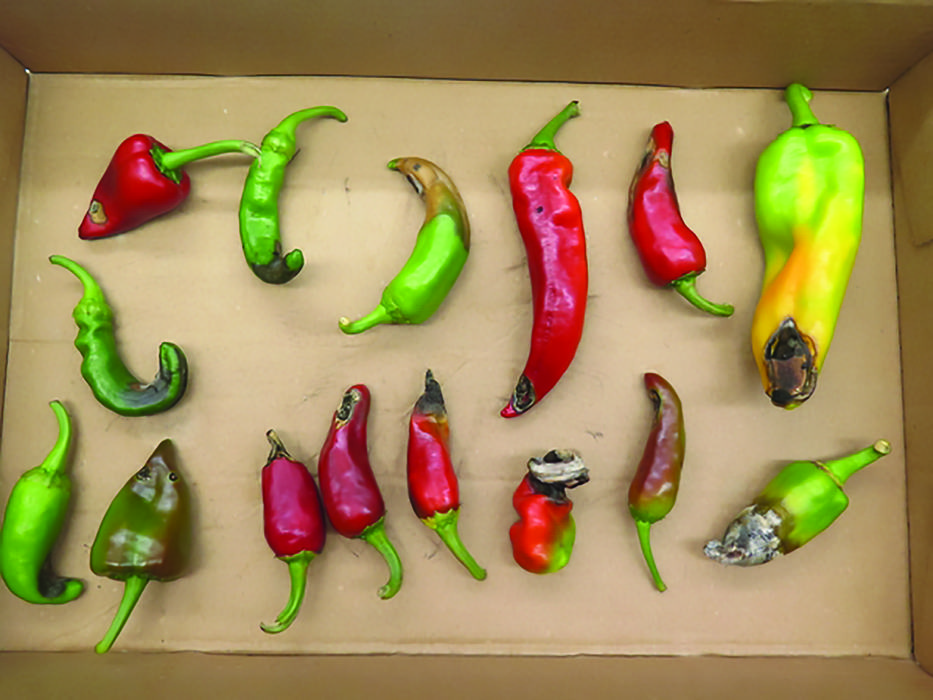
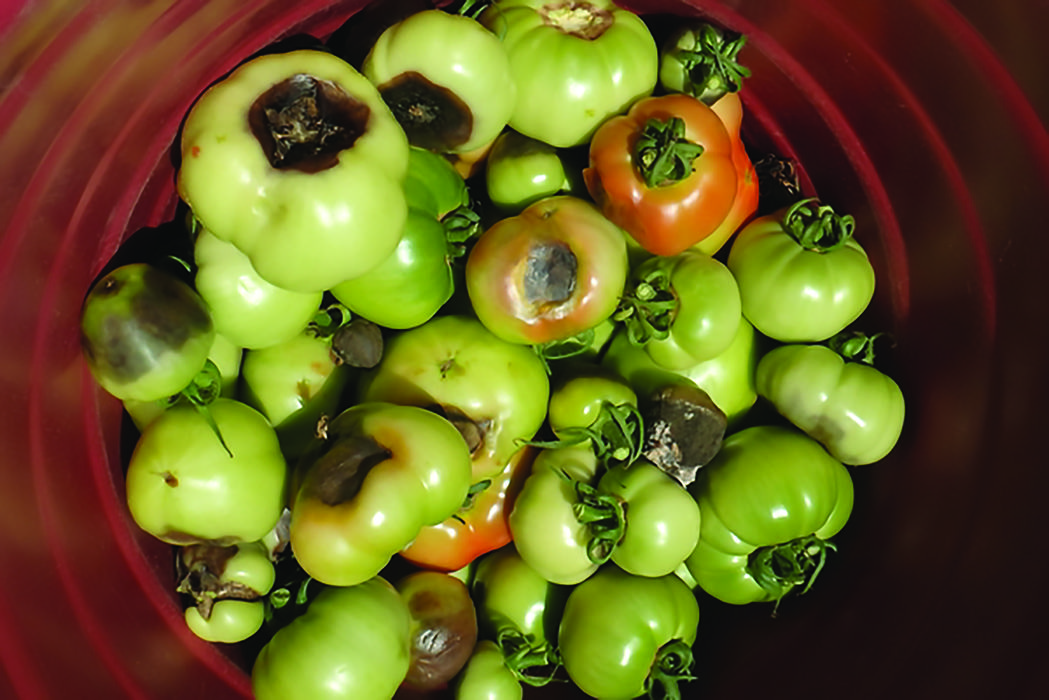
A concern that I’ve been hearing lately from growers is what turns out to be blossom end rot. Let’s learn more about it! Blossom end rot is a physiological disorder that commonly affects tomatoes, peppers, cucumbers, melons, and squash. It starts out as a small, water-soaked spot, kind of like a bruise, on the far end of a young fruit. As the fruit develops, the spot grows and darkens, turning sunken and leathery. As the affected tissue breaks down, opportunistic bacteria and fungi often attack the area, leading to further decay.
Now that we know what blossom end rot is, let’s take a look at what causes it. Blossom end rot is not a disease caused by bacteria or fungi, but rather a disorder that is the result of a deficiency in calcium. Calcium is important for the development of cell walls. As the tissues of young fruits are rapidly developing, they are in high need of calcium. When this demand is not being met, the call walls do not develop properly. The cells are weak in structure, leading to breakdown and rot in the far end of the fruit, the blossom end.
While it may be the case that your fruits’ calcium deficiency is the result of low calcium levels in the soil, it is often more likely that the calcium present is simply unavailable to your plant. One thing that can cause this is a low pH. Acidic soils can lock up nutrients in the soil, making them unavailable to your plants. This is why it is important to have your soils tested. You can pick up sampling boxes and paperwork at the Cooperative Extension office. A soil test report will tell you the pH of your soil. If it is too low, it will give you a recommendation for how much lime to apply to bring it up to ideal conditions, which is typically 6.0-6.5 for vegetables. Lime also contains calcium, thus providing some of the nutrient to your soil. If your pH does not need to be brought up, then a good source of calcium that won’t affect your soil acidity is gypsum. It is important to note that both lime and gypsum need to be incorporated into your soil and given a few months to react in the soil to be effective.
Aside from your soil’s calcium and pH levels, water is another important factor in blossom end rot. Calcium is an immobile nutrient in plants. It must be dissolved in water to move through the plant: taken in through the roots, up through the xylem, and distributed throughout the plant. Since calcium relies on water to move through the plant, and plants lose water through their leaves, calcium is more easily distributed to the leaves. Once there, calcium is not relocated to the fruits, because it is immobile. So, droughty conditions, inconsistent soil moisture, shallow watering, and high temperatures are all possible causes for blossom end rot. To avoid this, make sure you are keeping your soil consistently moist with regular waterings. You can also mulch around your plants to help reduce evaporation from the soil. If you are growing on plastic mulch, consider using white plastic. Soil temperatures under white plastic will be lower than under black plastic, which will help keep the roots functioning properly during the hot summertime. On the note of root function and water, it is important to consider that too much water can also be an issue. Water-logged soils are not ideal for root function and therefore negatively impact the uptake of nutrients, because such conditions limit oxygen availability.
If you are seeing blossom end rot on your fruits, it is best to remove them from the plant, as they will only continue to develop improperly. In addition to all the above to consider, it is also important that you help your plant invest in its fruits. To do this, make sure to avoid over-applying fertilizers high in nitrogen during the bloom and fruiting stages. Nitrogen encourages leafy growth and therefore diverts calcium from the fruits.
For more information, call the Franklin County Cooperative Extension office, 919-496-3344, Ag Agent, Alejandra Martinez, acmartinez1@ncat.edu
Blossom End Rot
(Updated: July 15, 2026, 9:48 a.m.)
Join our mailing list!
Enter your email address to receive updates.
Written By